Thursday, 14 February 2013
Saturday, 2 February 2013
Snippets of Research from this week...
I read about one recent exhibition at the Brooklyn Museum 'Materialising 'Six Years': Lucy R. Lippard and the Emergence of the Conceptual Art' looks to the processes of the Conceptual Art movement;
'showcases the artists brought together and championed by Lippard, and demonstrates how her curatorial projects, critical writing, and political engagement helped to redefine exhibition-making, art criticism, and the viewing experience'
I also read a review, which described as briliant, but, 'not a visually ingratiating show', with many of the pieces being documentations, photographic, and very ambiguous. Douglas Huebler is among these, producing work in numerous media often involving documentary photography, maps and text to explore social environments and the effect of passing time on objects. He suggests that the art object is obselete '"The world is full of objects, more or less interesting; I do not wish to add any more."
Something to consider, as how do we make this process or documentation exciting? Why is the object obselete? Can it be an object that reflects the documentation? It seems there can be too much Information, or is there too much Ambiguity in sculptural conceptual piece of art from the 60s, such as the minimalist period. It made me think about my BLANK pieces and the ideas I have about arousing this 'thoughfulness'; where is the middle ground?
It also made me think about the success of particpation, as I am currently trying to gain photos of peoples everyday, I have had few responses, so maybe its more about SETTING UP THE TIME OR SPACE myself...
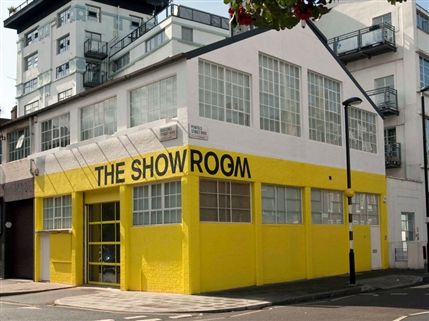
However, another interesting part of the week was a visit to the Whitworth for the Artist Talks series, where we listened to Emily from THE SHOWROOM London, which strangely centred around her ideas about the importance of ART-PARTICIPATION-RESEARCH within their gallery.
This gallery comissions artworks, provides a strating point for artists and first solo shows and importantly, branches out into its locality, important when such high art galleries, such as the Lisson Gallery are close by, where accessibilty and involvement with the art is limited by the locals. They aim to involve the locals, to become co-researchers in creating the art (but its not described as participation, as that suggest a pre-constructed outcome...). It was all very interesting stuff, the concept of the space made me really think about what I want to do with my art, and ideas about high art/low art sprung up in my head...
Further ponders/work required.
Friday, 1 February 2013
;to draw attention
Links to ideas about embellishing the everyday and that I could expand this to begin to set up a dialogue, between me and the viewer; setting up a time or space; what is high art/low art; temporality; and relational aesthetics..
The idea of BLANKING things out, links to the whole beginnings with BLANKS and arousing a thoughtfulness... I have been thinking specifically about the GM building after the talk with Kate, about commissions in general, and how it is important to have something site specific and bespoke to the space, but to also stay true to our own work and ideas...
BLANKS- in literature, maps, producing a 'blank' feelings (unheimlich) the idea of leaving things blank and not giving away too much information (Walter Benjamin), blank aesthetics of the building...
I am going to try and set up a dialogue with the users, or involve them in some way...
For now, these are my blanks of the GM building and other places around the city (above)...
Wednesday, 23 January 2013
A few artists on Stitch.
I have been thinking a lot about which materials and methods I want to use to create pieces, and after the quilting workshop ( which I rather enjoyed!) I have decided that I do love to sew, and have looked at a few interesting textile artists who try to challenge the notion and connotations of EMBROIDERY IN FINE ART
ElAINE REICHEK
A conceptual artists who uses embroidery to explore aesthetics in art. Originally trained as a painter, she works towards searching for a dialogue which links her work with the history of art, with insightful commentary on how meaning is portrayedm communicated and transmitted by way of visual imagery.
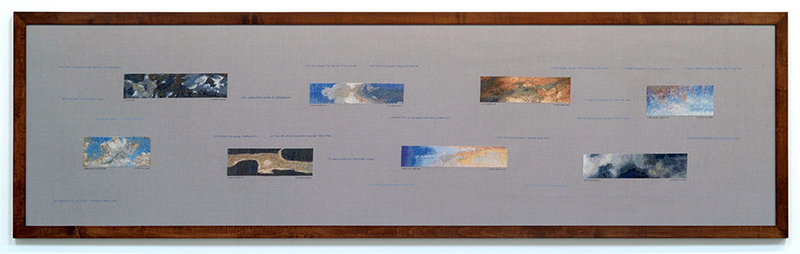
In one particular piece A Lexicon of Clouds, she looks at cloud formations of some of the great paintings by El Greco, Turner and Gerhard Richter and isolates 'overlooked indications of atmosphere' such as light, and creates new studies of them in stitch. This TRANSLATION is a key theme to her practice, where the action of embroidery sets up a dialogue between modes of creativity and the values assigned to them.
I think the idea of VALUE that is assigned to a particular practice is something that hits home with me, as I am constantly thinking about how valued embroidery and such work with fabric is assigned to it within the art world...
LOU CABEEN
Lou Cabeen has turned to embroidery 'for its social connotations- connotations of gender, of the decorative, of the domestic, private life.'
In particular, in Maps of Consciousness her use of stitch is to mediate the space between what is known and recorded in the outside world and inner states of consciousness. She comments on how the stitched line 'bespeaks time, it is an actual line a manifestation of effort and choice' as it would be to choose paint, plaster etc...
ROBERT RYMAN
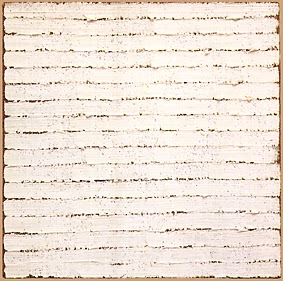
Not an embroiderer, but a conceptual artist from the minimalist period, whose ideas I find quite interesting. He did not like to describe himself as a 'picture-painter' but as an artist who works with real light and space and experiments with different materials such as linen, fibreglass, gouache and enamel.
BLANK...
Not trying to decorate; decoration is often associated with embroidery,
I always remember a quote from Louise Bourgeois about stitching, which always reassures and comforts me about my use of embroidery; 'The sewings is my attempt to keep things together and make things whole'. Probably not so comforting...But if sewing is good enough for Louise its good enough for me.
Tuesday, 22 January 2013
Boards.
One of the live projects I am working on is for Bench in Manchester; their focus is on the modern urban environment, handy, considering my last project was on MY MODERN URBAN ENVIRONMENT, but it was a little more than that, so decided to get the boards out to document exactly what I did, where I am and how it's going to help me in both my projects (the other being commission for GM)...
CONCEPT
AN AMBIGUOUS JOURNEY
'WE NEVER LOOK AT JUST ONE THING, WE ARE ALWAYS LOOKING AT THE RELATIONSHIP BETWEEN THINGS AND OURSELVES'
Began thinking about documenting and recording; gaps in time, finding the poetry, strangeness or mundane in the EVERYDAY. Starting point: series of windows.Wanted to carry on, extracting ideas about creating ambiguity, clouding connections, creating narratives and thinking about the everyday obscured. Documented through film camera, a window.
PROCESSES I
'WE MIGHT SET OUT INTENDING TO DESCRUBE WHAT WE SEE, BUT EVEN THEN WE DESCRIBE WHAT WE SEE THE WAY WE SEE IT.'
Thought about how to represent research, thought more abstract, the way I am seeing things. Documenting my everyday not just literal windows. COLOURs of the film processing was important, made places appear stranger, more/less enhanced. Thought about mapping my place/s through mapping colour, thinking about orientation.
PROCESSES II
'SUCH MOMENTS OF NONSENSE OCCUR WITHIN AND BETWEEN THE MUNDANE EVERYDAY ROUTINES OFFER AN ALTERNATIVE VISION OF REALITY IN WHICH THE LIMITS OF THE REAL WORLD CAN BE TEMPORARILY SET TO ONE SIDE.'
Thought about making things STRANGE. I made objects, plaster windows/viewfinders and juxtaposed, made pockets to HIDE and CONCEAL. Montaging: 'montage offers unusual combination that surprise and disturb habitual ways of seeing things. Thought about maps and how 'MAPS SUGGEST EXPLANATIONS' but considering ambiguous nature of project, the maps could suggest nothing at all. Thought about creating blank books, making things strange, painting photos and having moments of non-sense. Ideas hinting towards SEEING THINGS DIFFERENTLY.
WORKSHOP DEVELOPMENT AND SAMPLES
Decided to make books, as I have consistently documented through books and thought it would correlate to collate my own ambiguous narrative. Using Art Direction and Indesign workshops to help think about layout, inducted into bookbinding and the Risograph printer, new skills to produce new outcomes.
REFINEMENT OF IDEAS AND OUTCOMES
OUR RELATIONSHIP TO OTHER THINGS. WHAT IS ALREADY INSTALLED EVERYDAY?
Took a new collection of photos pulling together the ideas explored and realised, the journey of my journey in a way. Documented the development and installed in the same locations, resulting in a SERIES OF BOOKS, that reflect the nature of the project [possibly not quite right, but what I thought at the time, and still useful] and suggest ideas about the everyday and ambiguity.
Whilst pulling my ideas together, I realised how my concept had come to change to be about the EVERYDAY, thinking about installation but which considers and involves what is already installed, with a sense of ambiguity.
CARRY ON WITH
sense of ambiguity, strangeness
documenting, lots and using the film camera
communication, the design and layout...
CONCEPT
AN AMBIGUOUS JOURNEY
'WE NEVER LOOK AT JUST ONE THING, WE ARE ALWAYS LOOKING AT THE RELATIONSHIP BETWEEN THINGS AND OURSELVES'
Began thinking about documenting and recording; gaps in time, finding the poetry, strangeness or mundane in the EVERYDAY. Starting point: series of windows.Wanted to carry on, extracting ideas about creating ambiguity, clouding connections, creating narratives and thinking about the everyday obscured. Documented through film camera, a window.
PROCESSES I
'WE MIGHT SET OUT INTENDING TO DESCRUBE WHAT WE SEE, BUT EVEN THEN WE DESCRIBE WHAT WE SEE THE WAY WE SEE IT.'
Thought about how to represent research, thought more abstract, the way I am seeing things. Documenting my everyday not just literal windows. COLOURs of the film processing was important, made places appear stranger, more/less enhanced. Thought about mapping my place/s through mapping colour, thinking about orientation.
PROCESSES II
'SUCH MOMENTS OF NONSENSE OCCUR WITHIN AND BETWEEN THE MUNDANE EVERYDAY ROUTINES OFFER AN ALTERNATIVE VISION OF REALITY IN WHICH THE LIMITS OF THE REAL WORLD CAN BE TEMPORARILY SET TO ONE SIDE.'
Thought about making things STRANGE. I made objects, plaster windows/viewfinders and juxtaposed, made pockets to HIDE and CONCEAL. Montaging: 'montage offers unusual combination that surprise and disturb habitual ways of seeing things. Thought about maps and how 'MAPS SUGGEST EXPLANATIONS' but considering ambiguous nature of project, the maps could suggest nothing at all. Thought about creating blank books, making things strange, painting photos and having moments of non-sense. Ideas hinting towards SEEING THINGS DIFFERENTLY.
WORKSHOP DEVELOPMENT AND SAMPLES
Decided to make books, as I have consistently documented through books and thought it would correlate to collate my own ambiguous narrative. Using Art Direction and Indesign workshops to help think about layout, inducted into bookbinding and the Risograph printer, new skills to produce new outcomes.
REFINEMENT OF IDEAS AND OUTCOMES
OUR RELATIONSHIP TO OTHER THINGS. WHAT IS ALREADY INSTALLED EVERYDAY?
Took a new collection of photos pulling together the ideas explored and realised, the journey of my journey in a way. Documented the development and installed in the same locations, resulting in a SERIES OF BOOKS, that reflect the nature of the project [possibly not quite right, but what I thought at the time, and still useful] and suggest ideas about the everyday and ambiguity.
Whilst pulling my ideas together, I realised how my concept had come to change to be about the EVERYDAY, thinking about installation but which considers and involves what is already installed, with a sense of ambiguity.
CARRY ON WITH
sense of ambiguity, strangeness
documenting, lots and using the film camera
communication, the design and layout...
Tuesday, 15 January 2013
Blanks.
Blanks link in to the idea of blank spaces, blank maps and maps link in to my own 'quest for knowledge' as it could be put.
I have started off doing quite a lot of 'blank' drawings.
I have looked at satellite maps of GM building, and looked at its orientation- as to orientate was to locate east, therefore I have drawn what is east (repeated, distorted) and on further drawings, the colour and orientation on the paper was from the direction of east (well, an attempt anyway).
'INFORMATION LEAVES NOTHING TO THE IMAGINATION, FOR WE HAVE GIVEN IT ALL, AROUSING THOUGHFULNESS, STORY IS ART, A RANGE OF POSSIBILITIES.'
I have started off doing quite a lot of 'blank' drawings.
I have looked at satellite maps of GM building, and looked at its orientation- as to orientate was to locate east, therefore I have drawn what is east (repeated, distorted) and on further drawings, the colour and orientation on the paper was from the direction of east (well, an attempt anyway).
I started to think about colour being isolated, (a child's view of colour is quite isolated) and so little information being revealed.
The idea of blanks fits into my interest in the Everyday; blank, minimal MODERNIST work could be seen as quite unsettling, as remarked by Ben Highmore, MODERNISATION IS UNSETTLING. Very true at the moment, as we are moving into the new extremely modern art school, we find new and blank spaces unsettling, but they are awake with possibilites.
Blank spaces; paragraphs start with a blank. So these are notes on the amount of paragraphs/breaks in Georges Perec's Life, A Users Manual.
Also read a little of Walter Benjamin, where he hinted to the idea of blanks, or not giving everything away, in particular in story telling is most useful,
'INFORMATION LEAVES NOTHING TO THE IMAGINATION, FOR WE HAVE GIVEN IT ALL, AROUSING THOUGHFULNESS, STORY IS ART, A RANGE OF POSSIBILITIES.'
Monday, 14 January 2013
Maps of the Imagination
This is one of my favourite books I have read over the holidays, and has influenced my work/ideas for this unit quite a bit...
I was interested in ideas about maps and 'mapping the self' and so this was such an interesting read, linking the making of maps to literature and creativity in the arts in general.
I found so many amazingly enlightening things from this book that I even made mind maps of little interesting snippets and quotes, as it gave me so much to think about.
TO LEARN HOW TO READ ANY MAP IS TO BE INDOCTRINATED INTO THAT MAPMAKERS CULTURE.
One of the main things that I am taking with me on this project is the idea of BLANKS.
The first chapter, A LANDSCAPE OF SNOWS begins with how we start with a blank; A WORLD OF POSSIBILITIES.
So many interesting points such as: blanks being left intentionally, decorating maps as opposed to displaying knowledge, not having every piece of every information, hiding knowledge and secrets; maps represent the need for our information, but how much do we need to show, reveal?
It also mentions a lot about blanks in literature for example The Great Gatsby, 'writing on the principle of an iceberg, there is seven eighths underwater for every one eighth that shows'...
Hiding connections, creating ambiguity, creating a narrative...
Subscribe to:
Posts (Atom)


+001.jpg)