Showing posts with label Artists.... Show all posts
Wednesday, 7 November 2012
Everybody's Everyday.
We never just look at one thing, we are always looking at the relation betweens things and ourselves.
Our vision is continually active, continually moving, continually holding things in a circle around itself, constituting what is present.
JOHN BERGER
I like the idea of thinking about other people, an interactive element, possibily gaining information about what other people are looking at; what is outside their window?
As I am quite interested in installation art and sculpture, It could be quite nice to think of this project about having looked at which is already installed, what my everyday and other peoples everyday is...
LARA ALMARCEGUI-
WASTELANDS: A GUIDE TO THE EMPTY SITES OF AMSTERDAM
This artist looks at new ways of envisioning urban space through the contemplating of the unseen and unacknowledged, she created a document that guided people away from the tourist attractions of amsterdam to more downbeat, contingent, empty spaces in the outskirts of the city...
REVEALS NUANCES OF SPACE
POTENTIAL DREAM SPACES
Could be interesting to build on the idea of engaging people and thinking about the more unacknowledged and everyday urban environments that surround us...
Thursday, 4 October 2012
Leeds; Sarah Lucas
Went on a little trip to Leeds to get a little inspiration and see a few artists, most interesting was ORDINARY THINGS, a collection of sculpture by Sarah Lucas...
She looks at what sculpture can be: an object defined by gravity SPACE, the human body or naturally found forms, works with ORDINARY OBJECTS that shape our SURROUNDINGS and assumptions
USES PROCESSES like cutting moudling displaying and assembly
UTILISES CONVENTIONS that move from the monumental to readymades...
I came away from the exhibition with a lot to think about, especially the exploration about what is ordinary and thinking about surroundings and objects, which Is what I am currently investigating...Also about space and layout, as the layout aspects of the exhibition were also quite interesting...
She looks at what sculpture can be: an object defined by gravity SPACE, the human body or naturally found forms, works with ORDINARY OBJECTS that shape our SURROUNDINGS and assumptions
USES PROCESSES like cutting moudling displaying and assembly
UTILISES CONVENTIONS that move from the monumental to readymades...
I came away from the exhibition with a lot to think about, especially the exploration about what is ordinary and thinking about surroundings and objects, which Is what I am currently investigating...Also about space and layout, as the layout aspects of the exhibition were also quite interesting...
ordinary in extraordinary ways?...
Wednesday, 4 July 2012
Artists research- Janet Hodsgon...
JANET HODSGON
Janet Hodsgon is an artist with an interest in time and history, creating installations and ‘inscribing’ places inspired by archeological drawings.
She is interested
in archeology, in the removal of objects in a site, but mostly in the way DRAW TIME, in particular the stratigraphic
drawings and diagrams and how they
provide a visual way of seeing time, such as the Harris Matrix calendar which allows archeologists to see the stratigraphic sequences of complex sites...
Stratigraphy
Harris Matrix calendar
Her work
THE PITS-
sandblasted engraved drawings into the stones in Whitefriars, exact
stratigraphic copies of the site…
HISTORY LESSONS–video recording the fictional restaging of everyday life of the building in its previous incarnation as a Victorian school. Her videos in terms of history have 'evolved into an investigation of relationships that are as mush about location and dislocation, as they are about what was, what is and what might be’... sounds eerie!
Other interesting
points from a small essay I found (SEEING TIME/WRITING PLACE)
-
-‘calendars
and clocks faces are two ways in which we can see absolute time, for TIME has no physical reality, but is inherent in most things, it must be translated to a
diagrammatic form to be understood as sequence or schedule’ – so stratigraphic
diagrams fit into this.
- MATRIX-
the word matrix was used often…definition- an environment or materials in which
something develops.
-Architectural drawings are representations of spaces., in a
professional sense, but this could be transferred into more conceptual ideas…
-
The main point
which I found interesting was how she believes working in sites or historical
places, reinscribes the past into that place provides a way of seeing time. Themes of place, site, history and time all appear, all very interesting to me, and definitely ideas I am going to experiment with over the summer...
Wednesday, 27 June 2012
Installation, space and site...
These are a few themes I want to continue exploring throughout my work next year, and over the summer I think it would be good to look at artists and inspirations about site specific work, and the use of objects and spaces, HOW AND WHY.
A few artists to start, for inspiration...
SUKI CHAN
I went to the Chinese Arts Centre (it was changeover, but was still a useful trip...) and rediscovered Suki Chan in a few books that were on display.
She explores themes of place and 'uses light, moving image and sound to explore our physical and psychological experience of SPACE' and is drawn to using light, as it changes our daily perceptions of the spaces and places we encounter...She also collects objects and works with multiples to create interesting installations, something I find interesting as I like to explore things in 'series' and making things a little bit stranger.
A few artists to start, for inspiration...
SUKI CHAN
I went to the Chinese Arts Centre (it was changeover, but was still a useful trip...) and rediscovered Suki Chan in a few books that were on display.
She explores themes of place and 'uses light, moving image and sound to explore our physical and psychological experience of SPACE' and is drawn to using light, as it changes our daily perceptions of the spaces and places we encounter...She also collects objects and works with multiples to create interesting installations, something I find interesting as I like to explore things in 'series' and making things a little bit stranger.
| Interval II, Video |
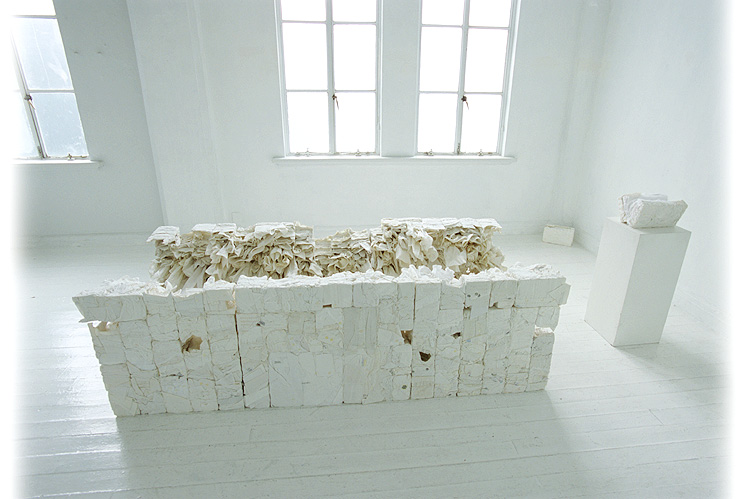
| Book Shelf Series, Cut books, metal and mirror. |
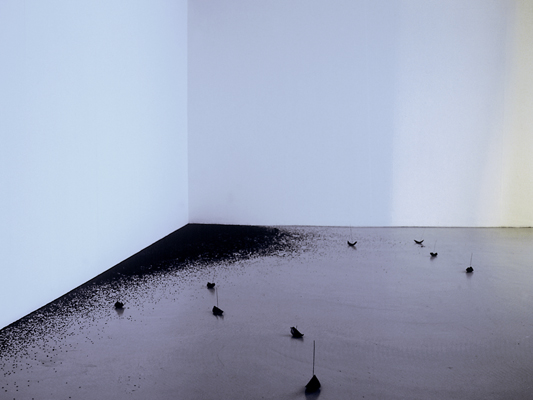
| Rice Boats, Mixed media installation with video |
I quite like how she works with unusual media, such as video projects and just the general clean, neat aesthetic of the work. Inspires me to do lots of detailed drawings!
ANTONIA LOW
This artist has featured on my blog before, but not with too much detail, so here is a little expansion...
Another installation artists who works with space and also looks at the history of sites 'A modern archeologist she looks back to the past, hoping to lay bare and discover treasures'.
'Has a special interest in sites under mutation'...She likes to work with rooms, removing objects and looking into the meaning of the spaces and 'past activities'.
| The Electric Return |
What was also interesting, was that she was part of the 'Seven Sites' project around Manchester and Salford, which was an event incurring many small, strange interventions and happenings among the communities and spaces around the city, such as tea parties in high rise flat blocks, video installations and performances in local pubs, Antonia in particular working in the United Reformed Church, Salford (right around the corner from where I used to live!)...
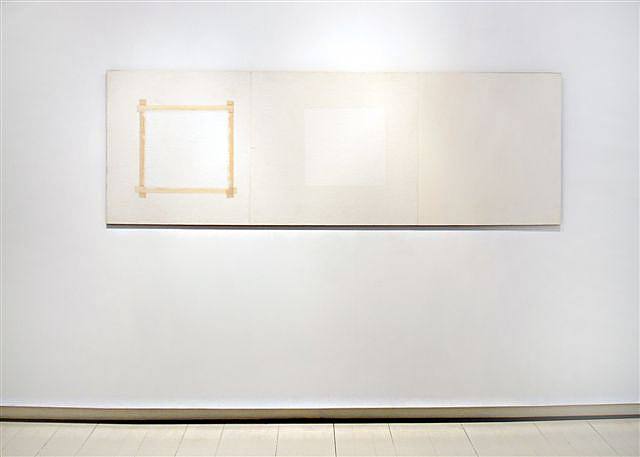
White Cube Longing focused on creating a white space, removing everything apart from the cupboard, which was to be built around to create a 'hyper-real space with a single object on view'.
| White Cube Longing |
I love the way she transforms space, and the historical/narrative aspect, trying to explore or look back to what was once there...The spaces she created look eerie, and even in the structures of her other pieces, it's described as being 'filled with a strange melancholy'...Agreed.
Monday, 14 May 2012
Astrid Stavro
Astrid Stavro is a designer, idea: Grid It! award winning products based on grids that have changed the history of design...
What caught my eye was that also in the caption was
'Order is the actual key of life' - Le Corbusier
I like grids, I like order, I quite like this designer, as everything is just so.
On with grids and regimented structures!
Monday, 7 May 2012
Tactile
As I plan to be working only with a few materials (as with a few of us in the group) , and our space could possibly be quite Blank, I have been looking at a few artists exploring quite a minimal theme...
Thomas Raschke; 'avid model builder' using a number of materials, frequently experimenting with iron-wire welded and soldered, his work questions edges and structures, lines and space.
Quite interesting, regarding the space. Also, has a very thready characteristic, quite wire-y, something I am trying to achieve with my work...
Antonia Low; Another artist from the tactile book...Amazing installations! They are, in fact, inspiring me to possibly work more with the wire/fabric/perspex element to my piece...
Very minimal qualities, materials and structures give an almost haunting feeling, a bit odd... I like odd.
Great book, as Mark said it was, so I will bring it in to the studio to see what peoples are thinking.
Labels:
Artists...,
Imagine-it Blog Autopost,
Unit X
Monday, 12 March 2012
Gregor Scheider
I think it's fitting I want to learn German for the amount of German artists that feature on my blog.
Gregor is another excellent germanic export, playing with ideas around Freuds uncanny or unheimlich. I knew I hadn't seen the last of this word...
Gregor features in the Tacita Dean 'Place' book (this book is a fave'), under subheading: fantastic. Agreed!
His work is an 'architectural reminder that Freuds uncanny, or unheimlich, is closely related to the homely, or heimlich'.
In Totes Haus (Dead House) walls are built in front of other identical walls, so changes are perceptible but unrecognisable; floors lined with sound insulating materials altering room characteristics invisibly...the 'increasingly oppressive atmosphere palpable nonetheless' ' a building of intense spatial and temporal dislocation'.
Most interestingly relevant, it is commented on how this could be considered a form of exploration of a greater collective memory and communities lost.
I'm thinking about this in conjunction with 'profound limitations of the the visual', Actaully altering places, creating a strange feeling of place... Buildings in Manchester are built over with completely different things, but what if it was to be replicating, place-ing elsewhere? Making multiples, identical and place-ing together?
Maybe I could visit dead places and spaces and houses around Manchester, and leave multiples of strangeness, for fun?
Gregor is another excellent germanic export, playing with ideas around Freuds uncanny or unheimlich. I knew I hadn't seen the last of this word...
Gregor features in the Tacita Dean 'Place' book (this book is a fave'), under subheading: fantastic. Agreed!
His work is an 'architectural reminder that Freuds uncanny, or unheimlich, is closely related to the homely, or heimlich'.
In Totes Haus (Dead House) walls are built in front of other identical walls, so changes are perceptible but unrecognisable; floors lined with sound insulating materials altering room characteristics invisibly...the 'increasingly oppressive atmosphere palpable nonetheless' ' a building of intense spatial and temporal dislocation'.
Most interestingly relevant, it is commented on how this could be considered a form of exploration of a greater collective memory and communities lost.
I'm thinking about this in conjunction with 'profound limitations of the the visual', Actaully altering places, creating a strange feeling of place... Buildings in Manchester are built over with completely different things, but what if it was to be replicating, place-ing elsewhere? Making multiples, identical and place-ing together?
Maybe I could visit dead places and spaces and houses around Manchester, and leave multiples of strangeness, for fun?
Sunday, 11 March 2012
A few artists...
I mentioned Cornelia Parker before to Hannah, and I think she is quite an interesting artist, especially as [in a book] it says she
'transforms destructive energy into poetic moments'
Which could be quite an interesting thought when/if thinking about events in Manchester...
I think the suggestion of turning energy into a poetic moment is quite a nice idea as I have been reading the 'Poetics of Space' (which to be honest was very confusing at the beginning, especially when it was talking about poetics and the poet) as its about transforming a feeling, or 'energy' or something into a poetic moment of some sort...
Bernd and Hilla Becher are also a duo I that came to mind...
They look into the history of the landscape in regards to technology and change, they take photos that are primarly visualy about the sculptural value, and are said to
'Focus on processes of production in an age that is increasingly dominated by images of consumption'
However, I also think from the images (whether intended) they create a sense of place, that being an empty place, dead space, showing 'spectres of the past'. It's possibly a more literal take on things, but I think the photographs are beautiful.
Tuesday, 6 March 2012
Numero 3: Hanne Darboven
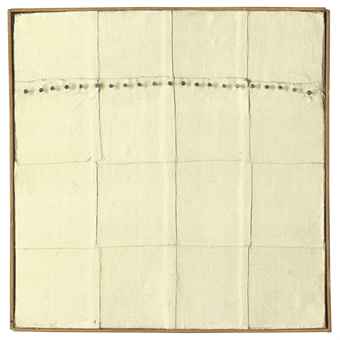
I think I was very lucky to discover (thanks to google) that an exhibition of Hanne Darbovens work was being show at the Camden Arts Centre in London. I have only recently come across her work, but she is someone I find very intriguing as she combines her practices as a pianist and mathematician to record time and her everyday, importantly trying not to create art.
The aesthetic value of her work was what initially drew me in; organised, notes, grids, minimal, thoughful, framed! And I really became interested about her ideas in time and systems and obsessiveness with what she was doing.
Saturday, 11 February 2012
Minimalism, Piero Manzoni and Gary Kuehn
After looking around the city gallery, I bought a book about minimalism and it got me thinking about the nature of minimalism, 'a new kind of art [in the 60s] inspired by mathematics and industrial process'. Flipping through, I felt what seems integral is materials, space, positioning and forms; much consideration and thought is needed so that all these are working together, even if the aesthetic is minimal.
Possibly could relate to my ideas about strange and everyday, in a minimal sense, as sometimes minimalism is the most strangest idea, people often react 'I could have done that' if it is something quite plain, or just because something is so blank, or unfinished or seemingly uninteresting...etc.
I don't want to make my work plain (as I am partial to a french knot session) I think somewhere my work could translate this idea, plain lines, colours, dots: normal regular things...just a little out of place.
Possibly could relate to my ideas about strange and everyday, in a minimal sense, as sometimes minimalism is the most strangest idea, people often react 'I could have done that' if it is something quite plain, or just because something is so blank, or unfinished or seemingly uninteresting...etc.
I don't want to make my work plain (as I am partial to a french knot session) I think somewhere my work could translate this idea, plain lines, colours, dots: normal regular things...just a little out of place.
Robert Ryman
Carl Andre
Ralph Humprey
Bit like Rachel Whiteread? 30 years earlier... Dan Flavin ![]() |
I really like the neon lights... I definitely want to think about light, and space maybe in the next projects, Dan flavin- excellent! I am quite liking the use of light, quite a lot of finnish artists are quite good with light...
Also...Gary Kuehn! Same time around Eva Hesse...
And Piero Manzoni (came up on google too!)
Lines and Dots!
Wednesday, 18 January 2012
Hanne Darboven, Agnes Martin.
Hanne Darboven
I really really like the whole simplicity, layout, colour scheme and form of this work. It's so detailed everything crammed in at the same time, yet it still seems peacefull...Makes me think about machine stitching...
Agnes Martin
These drawings make me very happy. I love the order, repetition and colour. I really love how it's so linear, but they are not boring or anything uninteresting at all. I really do loved order and lines and simplicity so this is really inspiring me to think about building on these ideas...
Saturday, 14 January 2012
Space and form
I have been doing a little bit of looking at some Japanese and Korean textile artists since my tutorial. These ones especially really caught my eye; use of space, how objects are placed in the spaces, the colours and the materials.
Machiko Agano
Kaori Hozozawa
Naoko Yoshimoto
Shindo Hiroyuki
I really like this piece! I think the strip of colour on one side works really well, and I think its quite subtle and but gives it a strange quality as its so bold...the use of colour is definitely something to think about, as my next workshop is dyefibrecloth, where I hope to push my use of colour...
Subscribe to:
Posts (Atom)